The Challenge
Why Bilton needed action
During the June 2007 floods, surface water ran off surrounding land and quickly overwhelmed local watercourses and sewers, pooling in low-lying spots across the village. Many homes sit below the level of adjacent roads and open spaces, making them particularly vulnerable when drainage systems are pushed beyond their limits.
The challenge is compounded by the flat topography of the region. With very little natural gradient, water that enters watercourses and sewers moves slowly – even during a flood event.
This backing-up effect means that even significant investment in new drainage infrastructure would be limited in its effectiveness without gravity to drive the flow. It's the same reason many older watercourses through the area were filled in over the years: stagnation, pollution and odour made them unworkable.
What Bilton needed wasn't bigger pipes, it was somewhere for the water to go.
The Solution
Sustainable drainage designed around the village
Rather than trying to move water faster, our approach focuses on storing it safely until the sewer network can cope.
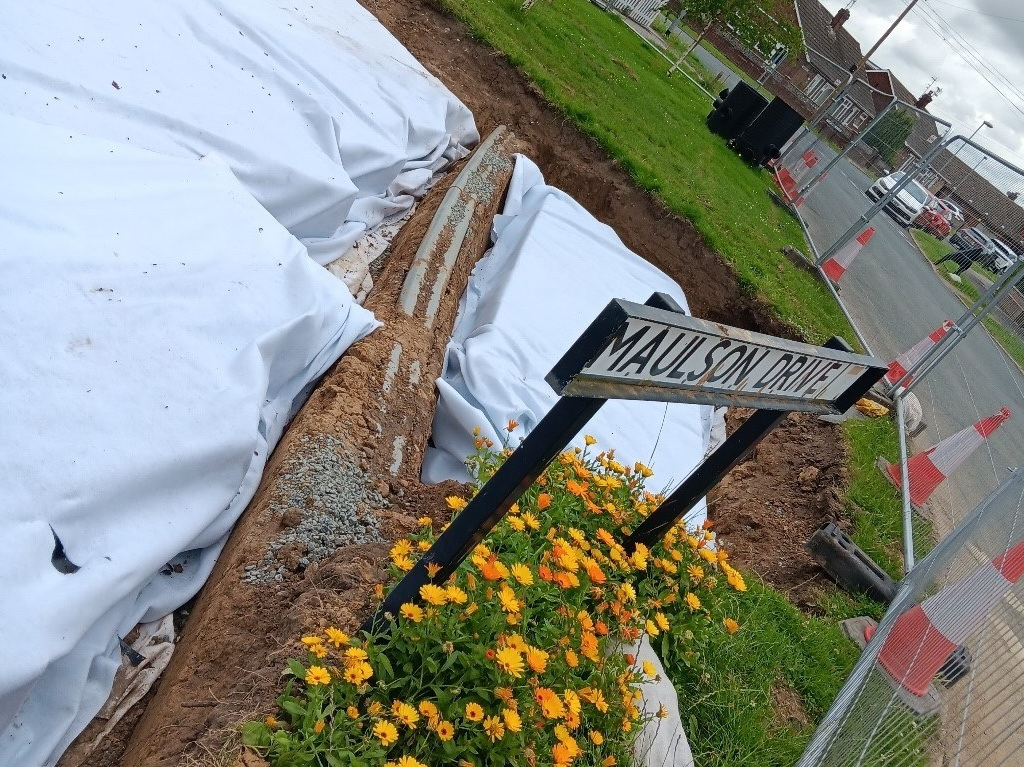
Working with Morrison Water Services, our schemes have been delivered across multiple sites around the village, using a combination of aquagreens, bioretention areas, detention basins within playing fields and beany block channels along roadsides. Each solution is designed to slow the flow of surface water into the existing sewer and watercourse system, holding it in managed areas rather than allowing it to reach homes or highways.
The use of playing fields as detention basins means that during normal or dry conditions the spaces function exactly as they always have. It's only during heavy, prolonged rainfall that they play their flood resilience role.
Designed with the community
Consultation with Bilton residents ran from October 2023 to March 2024, shaping both the location and appearance of the schemes. Drop-in events were held regularly throughout construction, giving residents the opportunity to raise concerns and receive updates at every stage.
Feedback was taken seriously. After significant community concern about the use of wildflower planting, a formal consultation was held in February 2025. With 83% of respondents in favour of reseeding areas with grass, the decision was made to honour that result. Where trees were removed to accommodate scheme infrastructure, three replacement trees were planted for every one lost – several of them in the grounds of Bilton Primary School, where students and staff were involved in the planting.
500³
of water stored in the village with more at the primary school
3
trees planted for every one removed
£0
cost to local residents – fully partnership-funded
Gallery
The Solution
What's changed for people living in Bilton
The SuDS installed across Bilton's green spaces and highways create a network of flood resilience infrastructure that works with the village's natural landscape rather than against it. Excess water is channelled into designed storage areas during heavy rainfall, releasing slowly back into the sewer system once the storm has passed.
Residents were closely involved throughout and Living With Water remains in regular contact with the community and the local parish council, with further updates shared via social media and community events.
Bilton Primary School has also played an active part in the scheme, with tree planting on school grounds ensuring the next generation is part of Hull and the East Riding's ongoing journey towards greater flood resilience.